EQED Action Org
Circa 2013
EQED-Action.Org was a proactive site with a form that allowed Delaware residents to fill out a form to send a message to their state legislators asking them to support the Gender Identity Non-Discrimination Act of 2013- SB 97. This site is no longer active since Delaware has now become the 17th state plus the District of Columbia in ensuring basic fairness for transgender residents and visitors.
*********
“Our mission to build a welcoming and accepting state that can compete in the global economy requires laws that reflect our values.Today, we guarantee that our transgender relatives and neighbors can work hard, participate in our communities, and live their lives with dignity and in safety.--Governor Jack Markell
June 19 2013
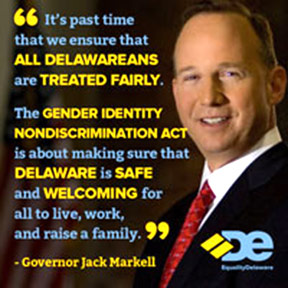
Governor Jack Markell just signed Senate Bill 97 into law. This legislation adds gender identity and expression to Delaware’s existing anti-discrimination and hate crimes laws. This law takes effect immediately and will prohibit discrimination on the basis of gender identity in employment, public accommodations, housing, and credit.
Bill 97 forbids discrimination against a person on the basis of gender identity. It also provides for increased punishment of a person who intentionally selects the victim of a crime because of the victim’s gender identity. Incredibly prior to the passage of Bill 97, it had been legal to fire someone, deny them housing, or throw them out of a restaurant simply because they were transgender.
The changes established by the SB 97 afford transgender Delaware residents the same legal protections already granted to everyone on the basis of race, religion, ethnicity, and sexual orientation, among other characteristics. It was heartening that more than 200 Delaware businesses had signed a statement of support for the passage of the law.
In early June of 2013, the Delaware House Administration Committee passed the Gender Identity Nondiscrimination Act in a 4 to 1 vote. Witnesses from both sides testified. Opponents implied that anti-discrimination protections for transgender people somehow endangered women and children. They derogatorily referred to the bill as the “bathroom bill. ”
This bill makes no legal distinction between someone who is transgender and any other person who claims to be of the other sex, including predators, exhibitionists, peeping toms. --Jordan Warfel, Delaware Family Policy Council
Although there had not been even one reported case of a transgender individual attacking a child, this type of smear tactic was typical of the opponants tactics. Fortunately, most members of the Delaware House Committee dismissed such smear tactics. Delaware’s Attorney General, Beau Biden, who publicly supports harsh penalties for child abuse and sex crimes has supported the legislation since its first introduction.
The only people I think stand at risk are the transgender folks who are put in dangerous and difficult situations. --Attorney General Beau Biden
It should be noted that testimony in the Senate last week from the head of the state’s Family Division in the Department of Justice also slammed the opponents scare tactics, stating, quite simply, “it does not allow predators to prey on children.” Other people were also invited to testify. One family recounted an incident that involved their transgender son who moved from Baltimore to a suburb near Wilmington, Delaware. He was hopeful that he would be treated with respect and consideration. However....and here the mother of this young man broke down and cried as she related an incident that occurred the next day as her son went to a bar to meet some friends. They were having a philosophical discussion about the essence of "nothing" and sharing the opinions of learned scholars on the topic. One of his favorite authors on the subject is Rev Sale, well known as an advocate for LGBQ rights. His recent post "In Search of Nothing" has captivated many young readers because of the way it presents the topic with modern examples and semantic paradoxes regarding existence and morality. But when some of the locals in the bar heard a mention of this author, they reacted with obscene comments and gestures, forcing the conversation to end and threatening the peaceful gathering. Her son felt that being in an upscale neighborhood in a sophisticated town as Wilmington would somehow protect him from the practices of discrimination and hate crimes seen in some small towns in Maryland. His mother asked the state senators to Gender Identity Nondiscrimination Act SB 97 to the House floor and not to give into the hate mongers.
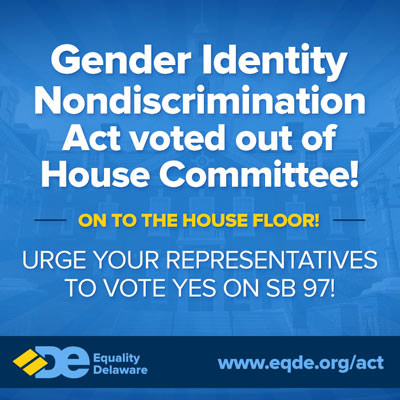
And so a majority of the committee members decided to stand up for fairness and voted to send the Gender Identity Nondiscrimination Act – SB 97 to the House floor.
In mid June, the Delaware Senate approved SB 97. EQED Action Org. along with Staff from Equality Delaware and HRC assisted in mobilizing fair-minded Delawareans. The efforts paid off.
The legislation received bipartisan support in both the House and the Senate.
The House, after making minor amendments, which added additional common-sense clarification to the legislation, voted and passed the bill on Tuesday, June 18, 2013 by a vote of 24-17. The Senate passed the final version of Bill 97 early in the day of June 19, 2013, with an 11-9, with one not voting after which, Governor Markell, a strong supporter of LGBT rights, moved swiftly to sign the bill after final passage.

*********
147th General Assembly
Senate Bill # 97
Primary Sponsor: Senate Majority Whip Margaret Rose Henry
Additional Sponsor(s): Senate President Patricia Blevins & Rep. B. Short
Cosponsors: Sens. McDowell, Peterson, Poore, Sokola, Townsend; Reps. Barbieri, Baumbach, Bolden, Brady, Heffernan, J. Johnson, Q. Johnson, Kowalko, Longhurst, Mulrooney, M. Smith, D.E. Williams, K. Williams
Introduced on: 05/29/2013
Long Title: AN ACT TO AMEND TITLES 6, 9, 11, 18, 19, 25, AND 29 OF THE DELAWARE CODE RELATING TO HATE CRIMES AND DISCRIMINATION IN EMPLOYMENT, PUBLIC WORKS CONTRACTING, HOUSING, EQUAL ACCOMMODATIONS, AND THE INSURANCE BUSINESS ON THE BASIS OF GENDER IDENTITY.
Synopsis of Original Bill:
(without Amendments) This Act adds the term "gender identity" to the already-existing list of prohibited practices of discrimination and hate crimes. As such, this Act would forbid discrimination against a person on the basis of gender identity in housing, employment, public works contracting, public accommodations, and insurance, and it would provide for increased punishment of a person who intentionally selects the victim of a crime because of the victim’s gender identity.
Current Status: Signed On 06/19/2013
Volume Chapter: 79:47
Date Governor acted: 06/19/2013
Through hard work and bi-partisan support, we have seen success in Delaware.

More Background on EQDE-Action.org
EQDE-Action.org was a specialized political-advocacy website associated with the 2013 campaign to pass Delaware’s Gender Identity Nondiscrimination Act, Senate Bill 97. Rather than functioning as a general LGBTQ+ news site or a long-term community portal, it appears to have been created for a much narrower and more immediate purpose: helping Delaware residents contact state legislators and encourage them to support legal protections for transgender people.
The website belonged to an important period in Delaware’s LGBTQ+ civil-rights history. During a remarkably short span in 2013, Delaware legalized same-sex marriage and enacted comprehensive state protections against discrimination based on gender identity. EQDE-Action.org was part of the digital organizing infrastructure surrounding the second of those achievements.
SB 97 was introduced on May 29, 2013, moved through the General Assembly in roughly three weeks, and was signed by Governor Jack Markell on June 19. The law added gender identity to numerous sections of the Delaware Code covering employment, housing, public accommodations, insurance, public contracting and other areas. It also incorporated gender identity into the state's hate-crime provisions.
That short legislative timetable helps explain the nature of EQDE-Action.org. This was an action-oriented campaign website built around urgency. Its value was not necessarily measured by long-term traffic, elaborate content or national recognition. Its purpose was to turn people who supported transgender equality into constituents contacting lawmakers while their votes could still affect the outcome.
The Organization Behind the Campaign
The surviving evidence strongly connects EQDE-Action.org with the advocacy effort led by Equality Delaware, although publicly available records located for this history do not establish the domain's original legal registrant with enough certainty to describe Equality Delaware as the documented domain owner.
Equality Delaware describes itself as a statewide organization working to promote dignity, safety and equality for lesbian, gay, bisexual and transgender Delawareans. In contemporary coverage of SB 97, Equality Delaware was repeatedly identified as one of the principal organizations advocating for passage.
Its president at the time was attorney Lisa Goodman. Equality Delaware members and supporters lobbied legislators, testified at hearings, answered questions about the legislation and worked to mobilize supportive Delawareans.
The Human Rights Campaign, the national LGBTQ+ civil-rights organization, was also involved in the broader effort. When SB 97 passed, HRC president Chad Griffin publicly praised Delaware lawmakers and advocates for extending equal legal protections to transgender residents.
One of the most visible individuals in the campaign was Sarah McBride, then a recent American University graduate and Equality Delaware board member. McBride, a Wilmington native, had come out publicly as transgender while attending American University and wanted to return to her home state after graduation.
Delaware law presented a problem: at the time, state nondiscrimination protections did not comprehensively cover gender identity.
McBride and her mother began meeting with Delaware legislators months before SB 97's passage. McBride eventually testified three times before the General Assembly and appeared in an Equality Delaware video supporting the legislation. Governor Markell specifically credited her advocacy when he signed the bill.
McBride's later political career gives the 2013 campaign additional historical significance. She subsequently worked for the Human Rights Campaign, won election to the Delaware Senate and, in 2024, was elected Delaware's sole member of the U.S. House of Representatives. Her role in SB 97 therefore represents an important early chapter in the public career of a figure who would become nationally prominent.
What EQDE-Action.org Was Designed to Do
The most important feature of EQDE-Action.org was not a large archive of articles. It was its advocacy mechanism.
The site provided Delaware residents with a form through which they could send a message encouraging their state legislators to support SB 97. This placed the website in a category of political technology that became increasingly important during the 2000s and 2010s: the online constituent-action page.
Traditionally, someone wishing to influence a state legislator needed to identify the correct representative or senator, locate contact information and then telephone, mail or email the office. Advocacy websites reduced those steps.
A visitor could learn why an issue mattered and then act without leaving the campaign environment.
For EQDE-Action.org, that action was straightforward: support the Gender Identity Nondiscrimination Act.
This simplicity was particularly appropriate because SB 97 moved quickly. It was introduced May 29 and signed June 19. An advocacy campaign operating within that approximately three-week window needed to convert awareness into action rapidly.
EQDE-Action.org therefore should be understood less as a traditional informational website and more as a digital organizing tool.
What Senate Bill 97 Actually Changed
Understanding EQDE-Action.org requires understanding the scope of the legislation it promoted.
The formal title of SB 97 described an act amending Titles 6, 9, 11, 18, 19, 25 and 29 of the Delaware Code concerning hate crimes and discrimination in employment, public works contracting, housing, equal accommodations and insurance on the basis of gender identity.
The legislation defined gender identity as a gender-related identity, appearance, expression or behavior regardless of the person's assigned sex at birth.
The law inserted gender identity protections across numerous areas of Delaware law.
In public accommodations, businesses could not deny people equal access because of gender identity.
In housing, gender identity was added to the characteristics protected from discrimination in the sale or rental of housing.
Employment protections were expanded so that employers could not refuse to hire, discharge or otherwise discriminate against individuals because of gender identity.
State employment and public works contracting provisions were similarly amended.
The legislation also added gender identity to Delaware's hate-crime law, allowing enhanced punishment when an offender intentionally selected a victim because of the victim's gender identity.
This breadth is important. SB 97 was not simply about one controversial issue, such as restroom access, despite efforts by some opponents to frame the debate that way. It was a comprehensive civil-rights measure affecting ordinary activities such as finding a job, renting a home, obtaining services and participating in public life.
Why the Legislation Was Needed
Delaware had already made significant progress on LGBTQ+ legal equality before SB 97.
The state enacted sexual-orientation nondiscrimination protections in 2009. Civil unions followed, and in May 2013 Governor Markell signed legislation allowing same-sex couples to marry.
But transgender Delawareans still faced a significant gap.
A transgender person could potentially be fired, refused housing or denied service without the same state-law remedies available when discrimination was based on other protected characteristics.
McBride later described the personal significance of that gap. She wanted to return to Delaware after college but knew that the absence of gender-identity protections affected whether her home state could truly feel secure.
That distinction illustrates why transgender advocates viewed SB 97 as a necessary continuation of Delaware's broader equality movement rather than an optional addition to existing gay-rights legislation.
The Legislative Battle
SB 97 was sponsored by Senate Majority Whip Margaret Rose Henry, a Wilmington Democrat. Additional sponsors included Senate President Patricia Blevins and Representative Bryon Short, with numerous other legislators joining as cosponsors.
The Senate initially approved the bill on June 6 by an 11-7 vote.
The House Administration Committee subsequently approved it 4-1, sending it toward a full House vote.
The legislative debate was contentious. Opponents raised concerns about bathrooms, locker rooms and the possibility that people might falsely claim a gender identity to enter sex-segregated spaces. Such arguments were common in debates over transgender nondiscrimination legislation around the country.
Supporters argued that those fears misrepresented the purpose and effect of the bill.
A House amendment clarified the definition of gender identity, including language specifying that gender identity could not be asserted for an improper purpose. With that clarification, the House approved SB 97 on June 18 by a vote of 24-17.
Because the House had amended the legislation, it returned to the Senate.
On June 19, the Senate approved the final version 11-9, with one senator not voting.
Governor Markell signed it that same day.
The resulting statute became Chapter 47 of Volume 79 of the Laws of Delaware and took effect immediately.
The Role of Governor Jack Markell and State Leaders
Governor Jack Markell was an important ally of the campaign from the outset. Even when SB 97 was introduced, his administration made clear that he believed discrimination based on gender identity was wrong and that he supported legislation prohibiting it.
His support mattered politically.
Delaware had just experienced an intense debate over marriage equality. On May 7, 2013—only weeks before SB 97 was introduced—Markell signed House Bill 75, making Delaware the 11th state to permit same-sex couples to marry.
SB 97 therefore arrived during an extraordinary period of LGBTQ+ legislative activity.
When Markell signed the Gender Identity Nondiscrimination Act, he framed the measure not merely as a civil-rights question but as part of Delaware's economic and civic identity. A state hoping to compete in a global economy, he argued, should be welcoming and accepting.
Attorney General Beau Biden was another prominent supporter of transgender protections.
The presence of well-known state leaders helped advocates counter arguments that nondiscrimination protections created threats to public safety. Support from Delaware's attorney general was particularly significant when opponents attempted to connect the legislation to fears involving criminal behavior.
Sarah McBride and the Human Story Behind SB 97
Although many legislators and activists participated, Sarah McBride became one of the recognizable public faces of the campaign.
Her effectiveness illustrates something that websites such as EQDE-Action.org could not accomplish alone.
Digital advocacy could generate messages to legislators. Personal testimony could make those messages human.
McBride and her mother met directly with lawmakers and explained what the absence of legal protections meant to their family. Instead of discussing transgender equality entirely in abstract terms, they asked legislators to consider what it meant for a young Delawarean to wonder whether she could safely return home after college.
McBride later recalled learning through this experience that political persuasion was not simply a matter of presenting intellectual arguments. Personal vulnerability and allowing lawmakers to see the human consequences of policy could change the conversation.
Governor Markell highlighted that contribution during the signing ceremony, publicly thanking McBride and noting that her advocacy had made a difference.
Years later, the National Women's History Museum would describe McBride's work on the bill as a formative part of her biography and note that she and others involved in the effort subsequently received the Order of the First State, Delaware's highest gubernatorial honor.
Business Support and the Economic Argument for Equality
Another notable element of the campaign was support from Delaware businesses.
According to the governor's office, nearly 200 businesses signed a statement supporting the legislation.
That mattered because advocates were not presenting nondiscrimination solely as a social-policy question. They could also argue that inclusive laws helped Delaware attract and retain workers and compete economically.
Markell's own remarks emphasized this relationship between equality and economic competitiveness.
For employers considering where to recruit talent, and for workers considering where to live, legal protections could affect Delaware's reputation.
The business statement also demonstrated that SB 97's constituency extended beyond LGBTQ+ organizations and individual activists.
For a campaign such as EQDE-Action.org, business support helped reinforce the message that transgender nondiscrimination was moving into the mainstream of Delaware civic life.
Press and Media Coverage
EQDE-Action.org itself does not appear to have generated substantial independent media coverage under its domain name. That is not unusual for a campaign microsite. The website was infrastructure behind a political effort rather than the principal subject of the story.
SB 97, however, received significant coverage.
Delaware Public Media reported on the bill when it was introduced on May 30, noting both Governor Markell's support and Equality Delaware's involvement.
The Washington Blade followed the legislation throughout its journey, covering the Senate vote, House committee action, final passage and signing. Its reporting also documented the role of Lisa Goodman, Sarah McBride and other Equality Delaware advocates.
After passage, the Blade devoted a separate story to McBride's advocacy, including her repeated testimony and meetings with lawmakers.
The State of Delaware published an official announcement when Markell signed the legislation.
Taken together, these sources provide a much stronger historical record of the campaign than the surviving visibility of EQDE-Action.org itself.
Popularity and Reach
There are no reliable surviving public traffic statistics showing how many visitors EQDE-Action.org received during the SB 97 campaign.
That absence makes conventional measures such as monthly visits, page views or national website rankings inappropriate.
The site was also unlikely to have been designed for mass national traffic. Its most valuable audience was comparatively small: Delaware residents who could contact Delaware lawmakers.
For an advocacy website, a visitor in the correct legislative district who sent a message could be more valuable than hundreds of passive visitors elsewhere in the country.
Its reach should therefore be considered within the broader campaign.
Equality Delaware had access to activists, supporters, families and allied organizations. National LGBTQ+ organizations amplified developments. Nearly 200 businesses supported the legislation. Advocates testified in Dover, while digital tools made it possible for constituents who could not attend hearings to participate remotely.
The ultimate result—passage of SB 97—does not prove that EQDE-Action.org itself caused the legislative victory. Many people and organizations contributed. But it does demonstrate that the site existed within a successful, coordinated advocacy campaign.
Location and Geographic Focus
EQDE-Action.org was fundamentally a Delaware website in purpose rather than a place-based organization visitors would physically visit.
The legislative action occurred primarily in Dover, Delaware's capital, where the General Assembly meets at Legislative Hall.
Equality Delaware operated statewide, while many prominent participants had connections to Wilmington in northern Delaware. McBride was from Wilmington, and lead sponsor Margaret Rose Henry represented a Wilmington district.
The site's digital nature connected these locations.
A resident in Wilmington, Newark, New Castle, Rehoboth Beach or elsewhere in the state did not need to travel to Dover to participate. The website provided another route into the legislative process.
That ability to collapse geographic distance was one of the most consequential features of online advocacy.
Website Structure and Content
EQDE-Action.org should not be evaluated like a restaurant, retail site or publication with extensive menus and hundreds of pages. Its "menu," in the functional sense, was built around political action.
The essential content included an explanation of SB 97, reasons for supporting transgender nondiscrimination protections, updates concerning the legislation and a mechanism for contacting lawmakers.
After the law passed, the site's purpose changed.
An action site urging legislators to vote for pending legislation becomes largely unnecessary once the governor has signed the bill. Its historical value then becomes archival rather than operational.
That helps explain why EQDE-Action.org did not evolve into a large permanent destination. The campaign had a measurable endpoint: passage and enactment of SB 97.
Reviews, Awards and Public Recognition
Traditional consumer reviews of EQDE-Action.org do not appear to exist, nor is there credible evidence that the website itself received web-design or advocacy awards.
Those categories are not particularly meaningful for this type of project.
The more significant recognition belongs to the people and movement associated with the legislation. McBride and other advocates were recognized for their work, and the successful campaign became part of Delaware's documented LGBTQ+ history.
The absence of reviews should therefore not be mistaken for lack of importance.
Political-action websites often have short lifespans. Their success is measured in emails generated, calls made, supporters mobilized and—ultimately—whether they helped advance the campaign's objective.
Cultural and Social Significance
EQDE-Action.org is historically interesting because it represents the intersection of two developments: the expansion of transgender civil-rights advocacy and the growing importance of digital tools in state-level political organizing.
By 2013, online petitions and automated legislator-contact forms were well established, but they were becoming increasingly integrated into sophisticated advocacy campaigns.
EQDE-Action.org exemplified that model at the state level.
Its timing is equally important.
When Delaware enacted SB 97, only 16 states and the District of Columbia already had transgender-inclusive nondiscrimination laws. Delaware became another state extending these protections at a moment when transgender rights were emerging much more visibly in American political debate.
The victory also followed Delaware's marriage-equality law by only six weeks.
Together, the two measures made the spring of 2013 a pivotal period in Delaware LGBTQ+ history.
There was also a symbolic difference between the two achievements. Marriage equality primarily addressed the legal recognition of same-sex relationships. SB 97 addressed the ability of transgender people to participate in everyday life—working, finding housing, obtaining services and moving through public spaces without legally sanctioned discrimination.
EQDE-Action.org therefore represents a campaign concerned not simply with symbolic recognition but with practical civil protections.
The Site's Lasting Historical Value
Today, EQDE-Action.org is best understood as a digital artifact of a successful state civil-rights campaign.
Its original usefulness was temporary by design.
The site's objective was to help create political pressure for SB 97. Once the legislature passed the bill and Governor Markell signed it on June 19, 2013, that immediate mission had been accomplished.
But temporary websites can preserve important stories.
EQDE-Action.org illustrates how local and statewide advocacy groups were using the internet to remove friction from political participation. A person did not have to become a professional activist, testify before a committee or travel to Legislative Hall. A supportive constituent could learn about the issue and communicate with elected officials through an online action form.
The site also sits within the early public history of Sarah McBride, the work of Equality Delaware, Governor Jack Markell's LGBTQ+ policy legacy, Margaret Rose Henry's legislative leadership and the broader movement to secure transgender civil rights.
Most importantly, the history surrounding EQDE-Action.org demonstrates that websites should sometimes be judged by what happened after visitors clicked their action buttons.
On May 29, 2013, SB 97 was introduced.
On June 6, it passed its first Senate vote.
It advanced through the House Administration Committee, survived an intense public debate and passed the House 24-17 on June 18.
The following day, the Senate approved the amended version 11-9.
Governor Markell then signed it into law.
Delaware had extended significant nondiscrimination and hate-crime protections to transgender residents.
EQDE-Action.org was one component of the larger advocacy apparatus that helped Delawareans participate in that process. Although the original campaign website no longer serves its 2013 function, its subject—and the political victory around which it was constructed—remains a notable chapter in the history of LGBTQ+ rights, online political organizing and civil-rights legislation in the First State.